Launch offer — valid today only

📄 Digital book in PDF · read it on your phone or print it

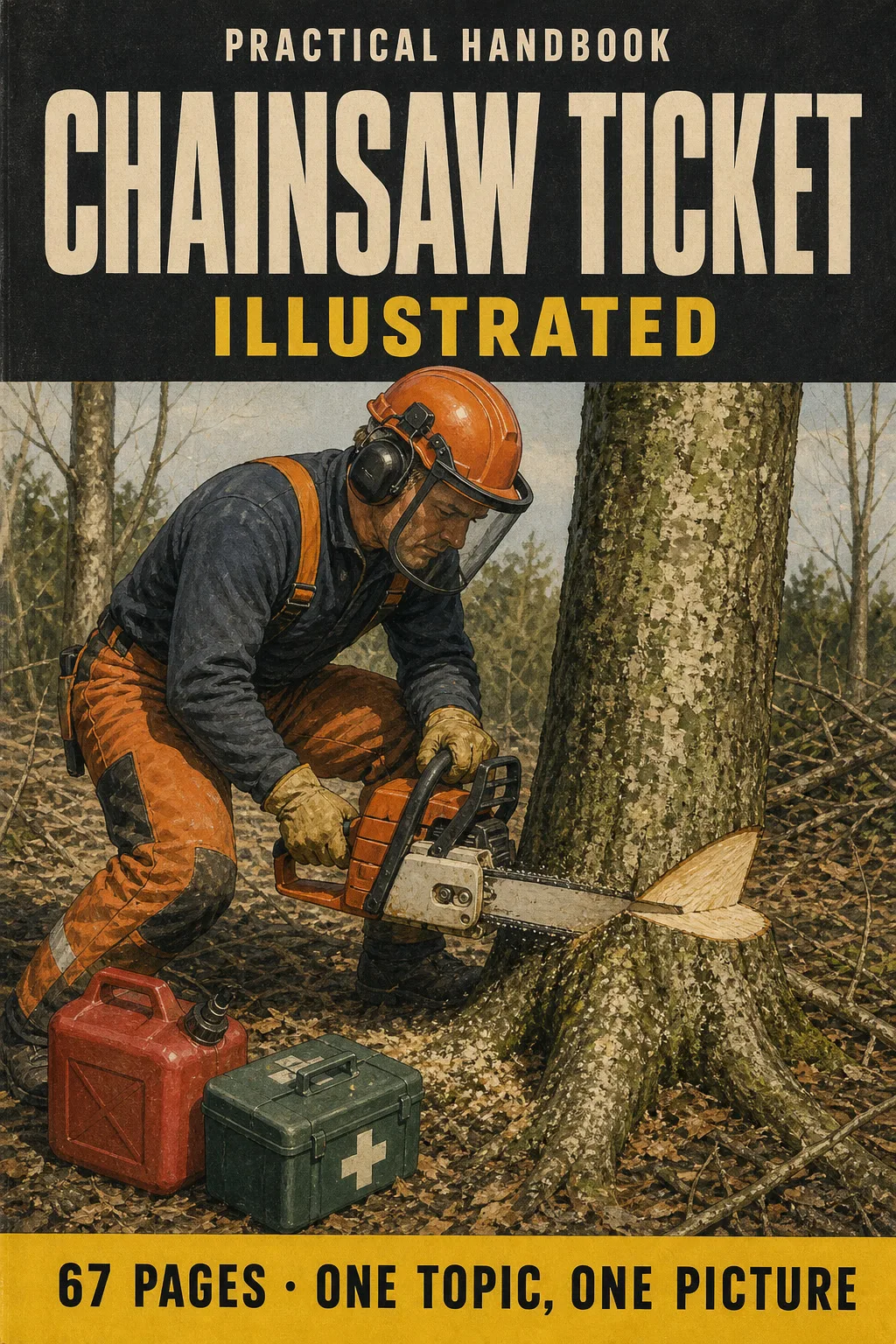
The Chainsaw Ticket in Drawings: Talk the Assessor Through Every Check and Cut Every Check and Cut, One Page

For the CS30 and CS31 assessments: pre-use checks, chain sharpening, two-stroke fuel, kickback, tension and compression, the danger zone, the sink, the hinge and the back cut. Every topic has its own page: the drawing first, then what you need to remember. 67 illustrated pages.

START REVISING THIS WAY

🔒 Secure checkout · PDF by email · 30-day guarantee

Every topic, its own pageEach check and cut drawn, with the explanation alongside
67 illustrated pages9 parts, from what your ticket covers to the final checklist to print
Up-to-date sourcesHSE guidance, the PUWER ACOP (L22) and FISA safety guides
PDF by emailFormat

Look Inside the Book

Every page has one big drawing and a box with the measurements, angles and steps you need to know:

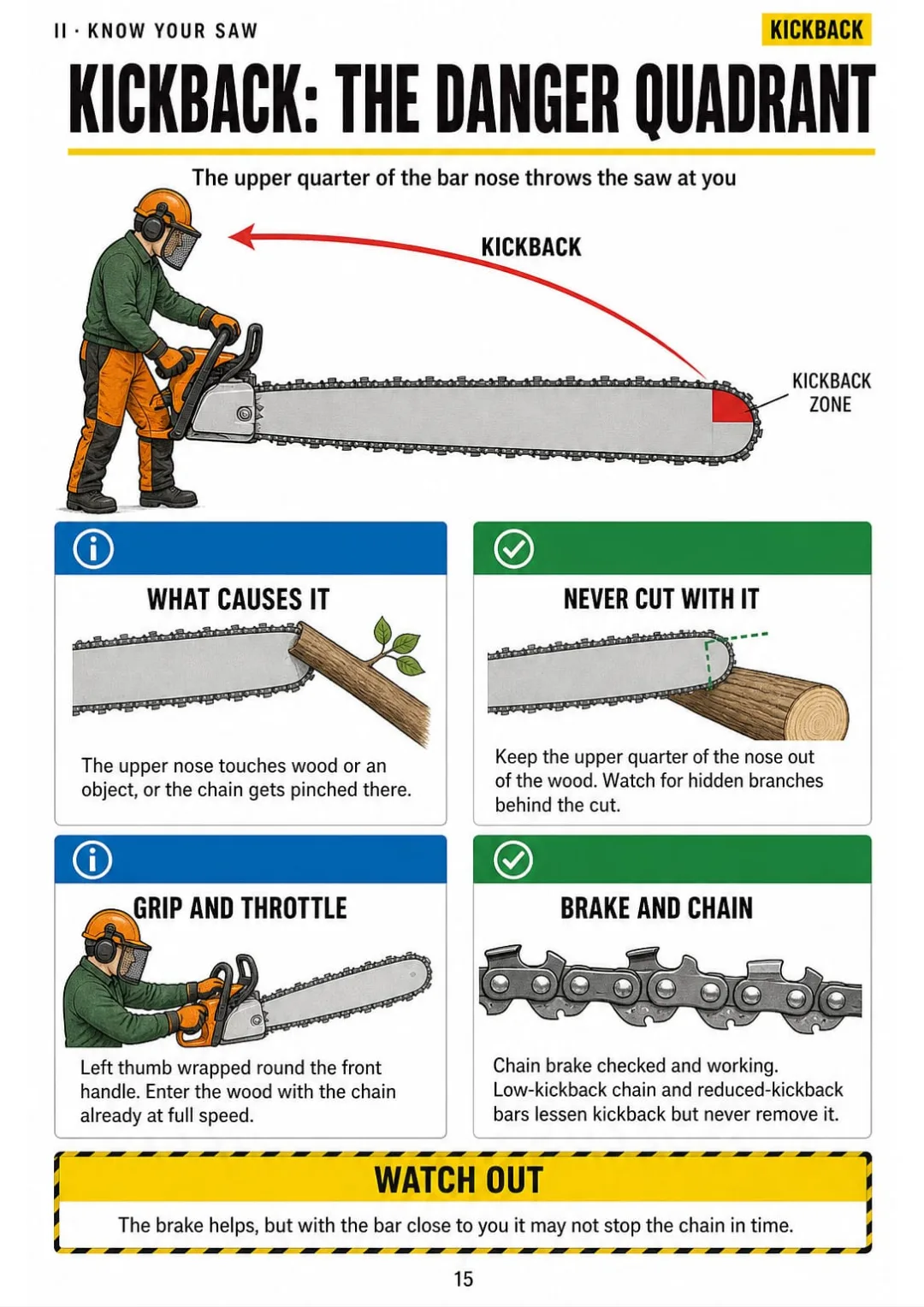
Upper quarter of the nose = kickback zone, and four ways to keep it out of the wood
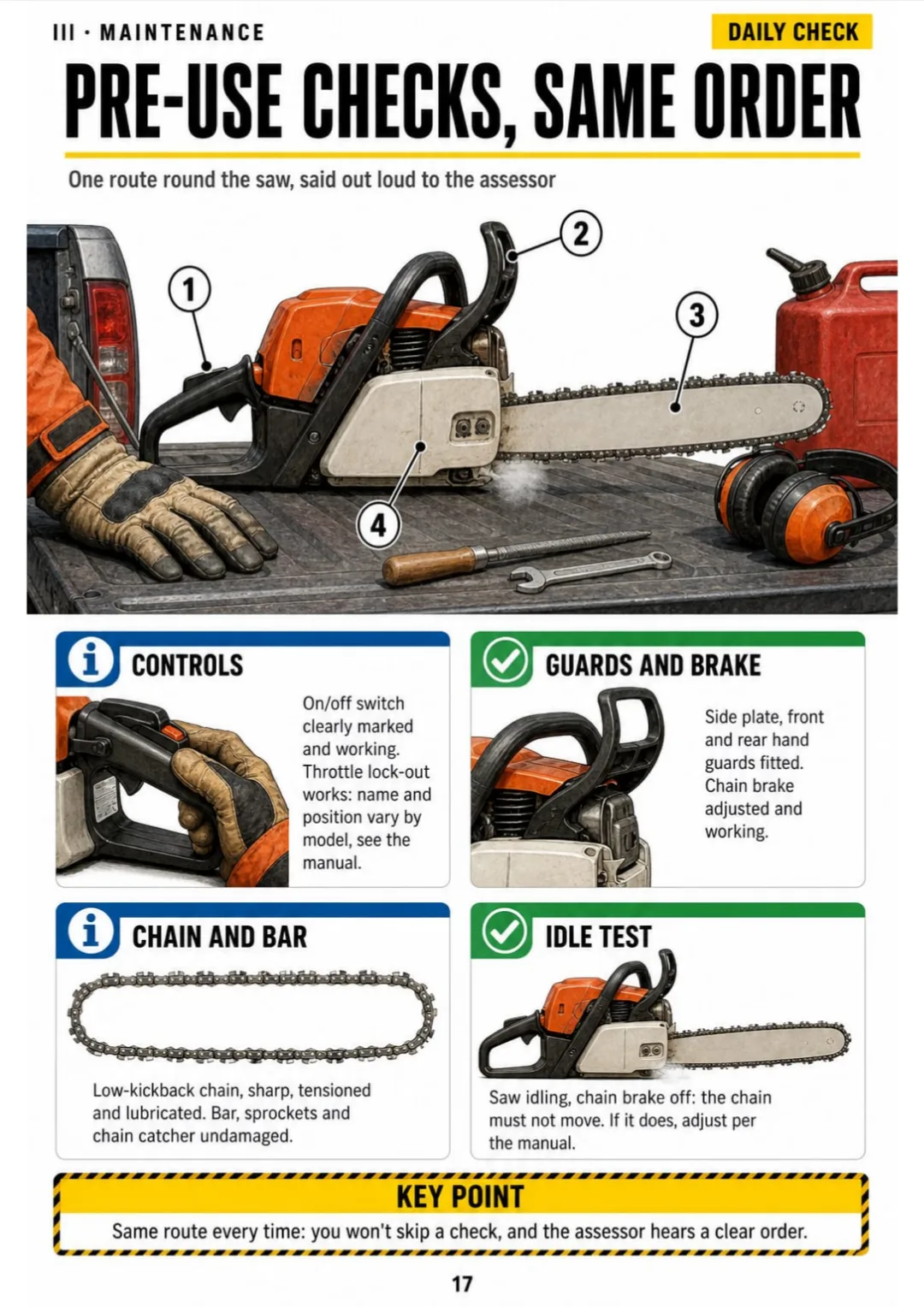
Switch, guards, brake, bar, chain catcher, silencer, mounts and the idle test, in one route.
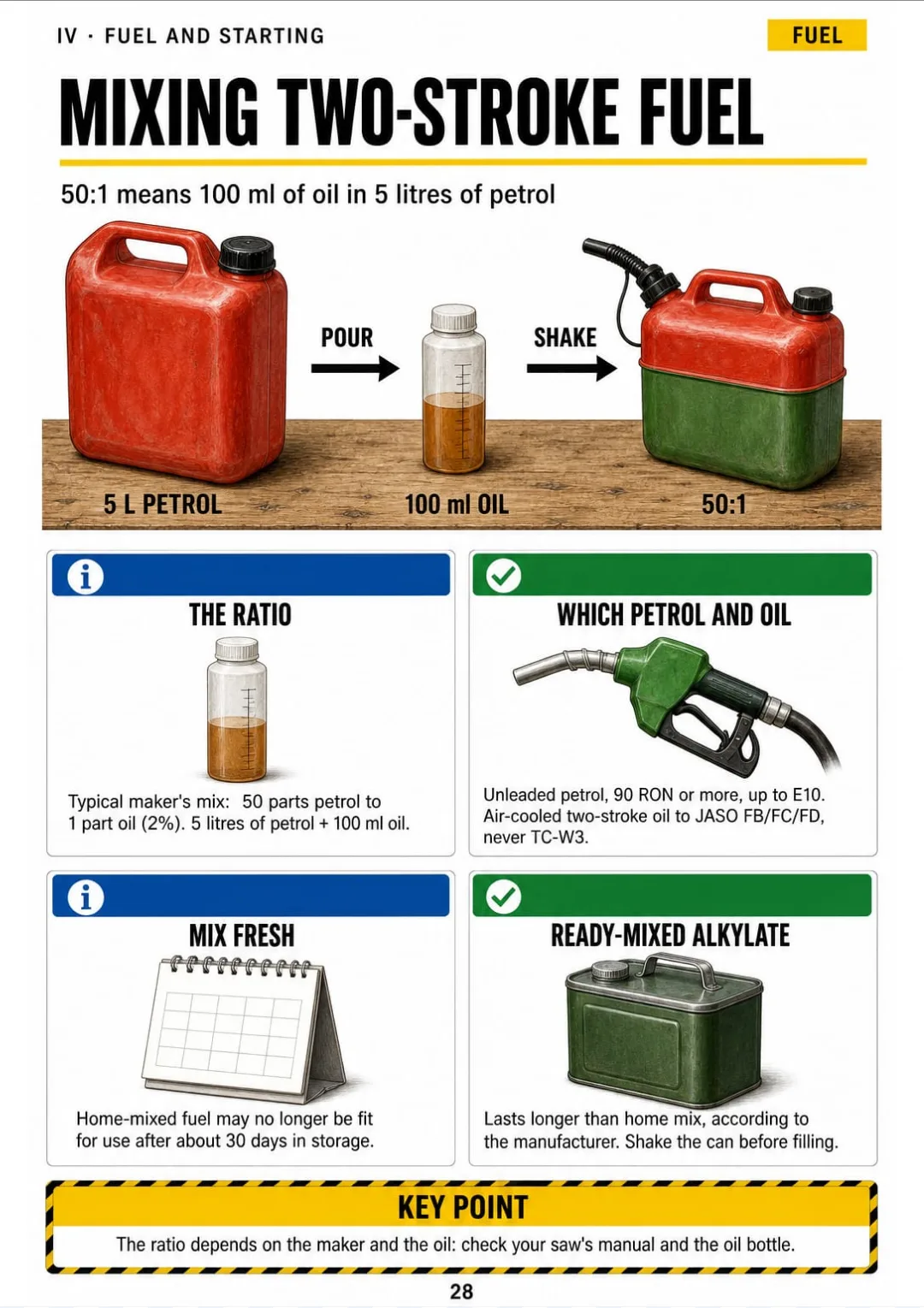
50:1 = 5 litres of petrol + 100 ml of two-stroke oil, mixed fresh
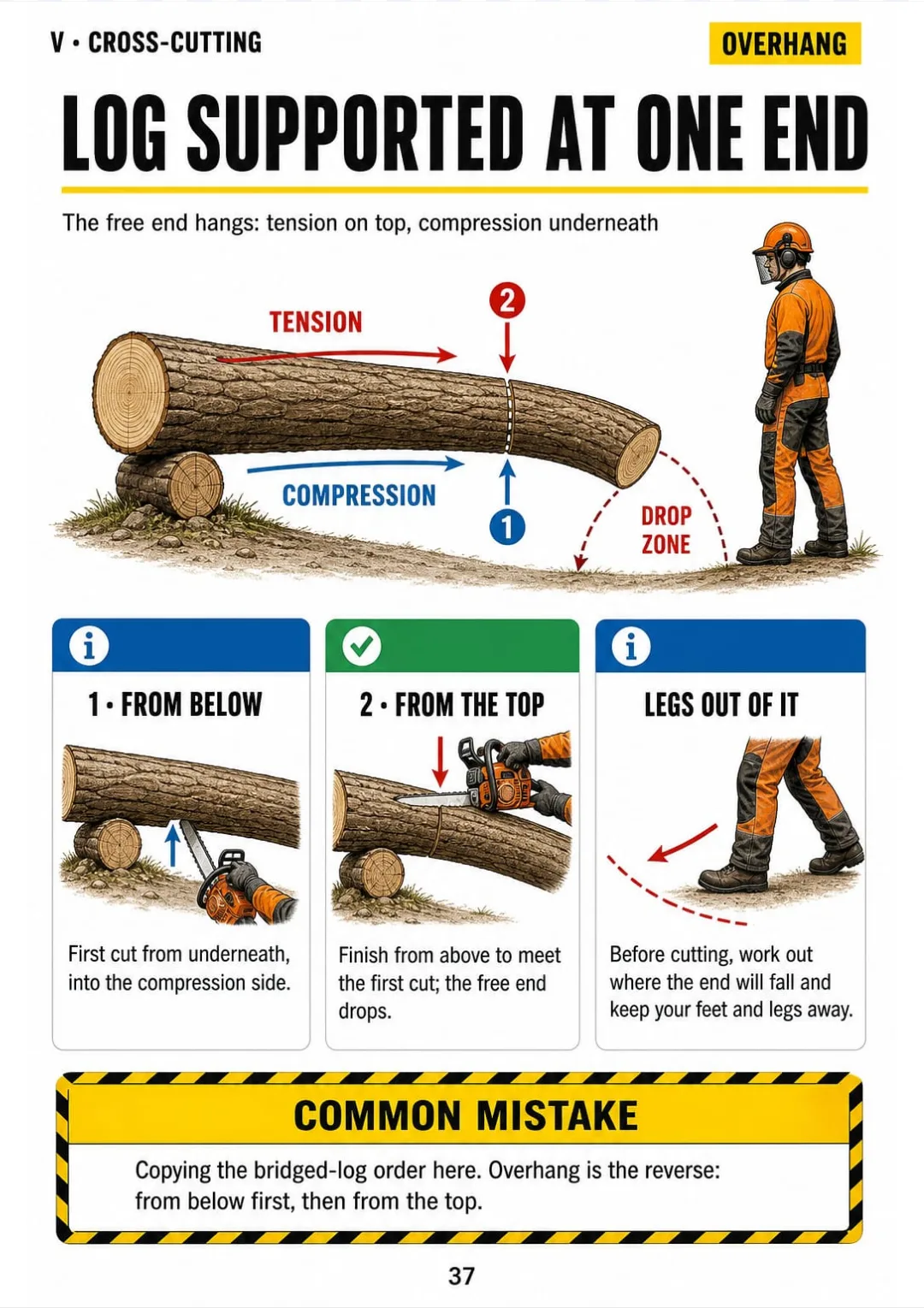
Supported at one end: tension on top, compression underneath. Cut 1 from below, cut 2 from above.
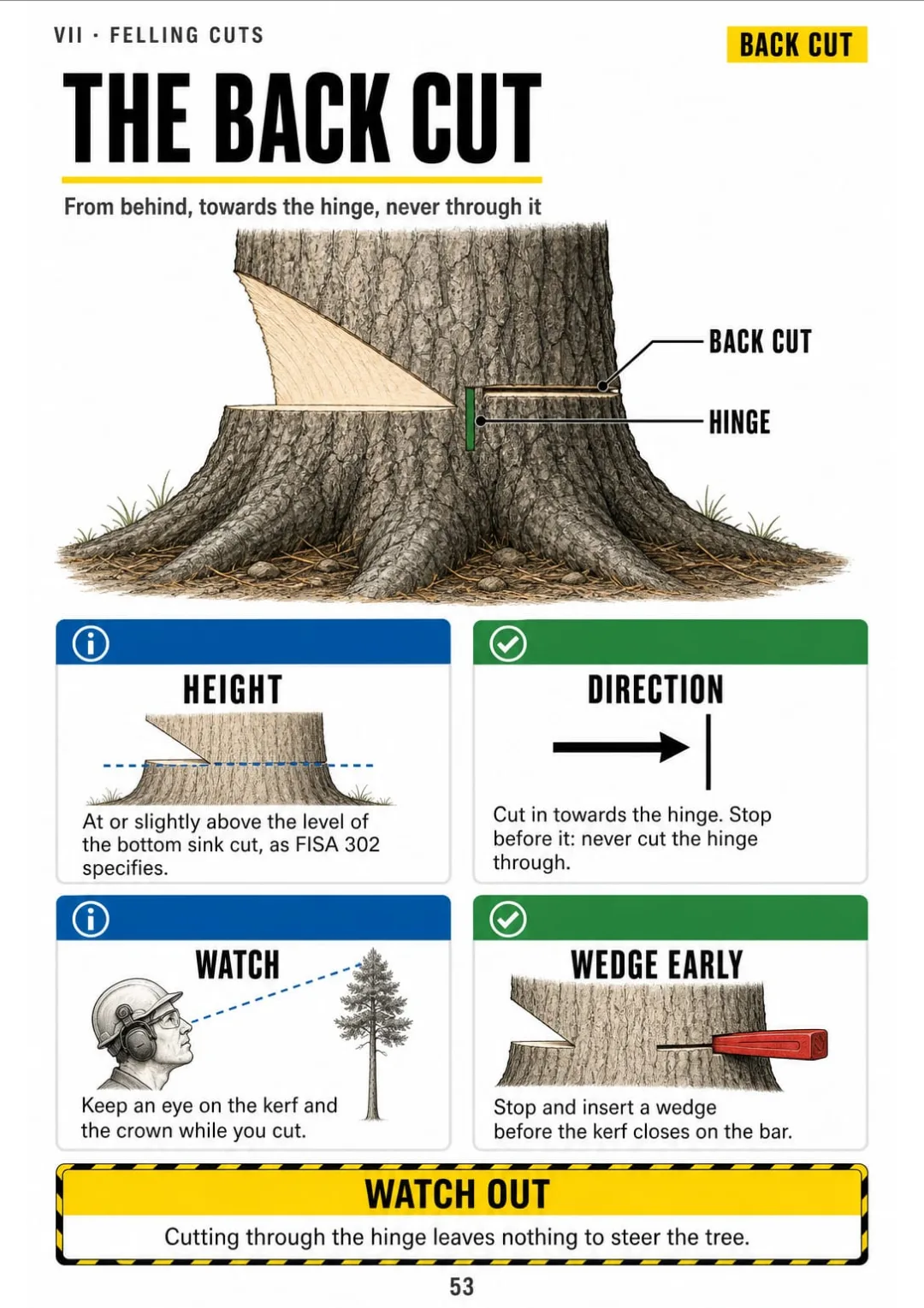
Back cut: at or slightly above the bottom sink cut, never through the hinge
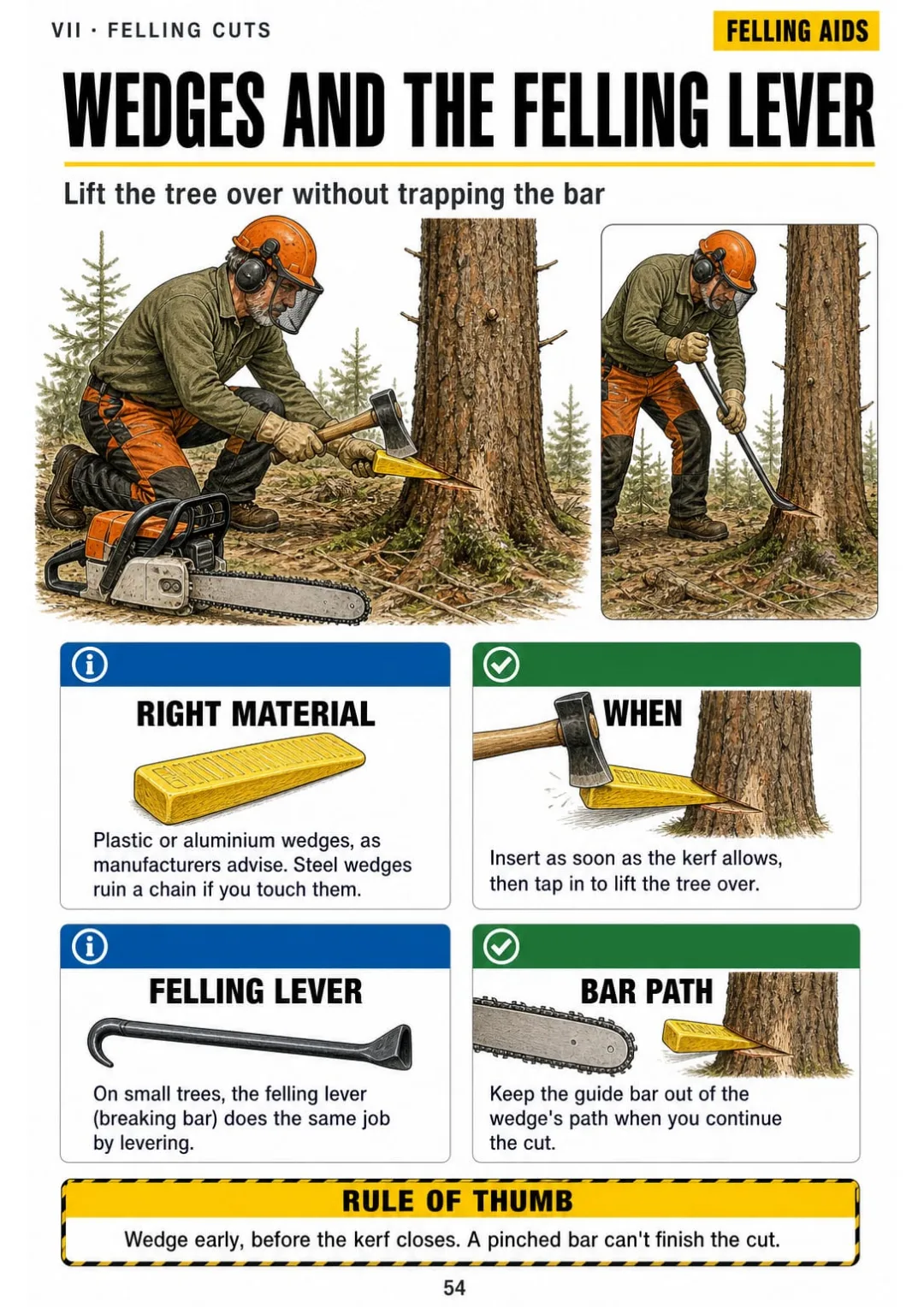
Plastic or aluminium wedges, felling lever on small trees, bar out of the way
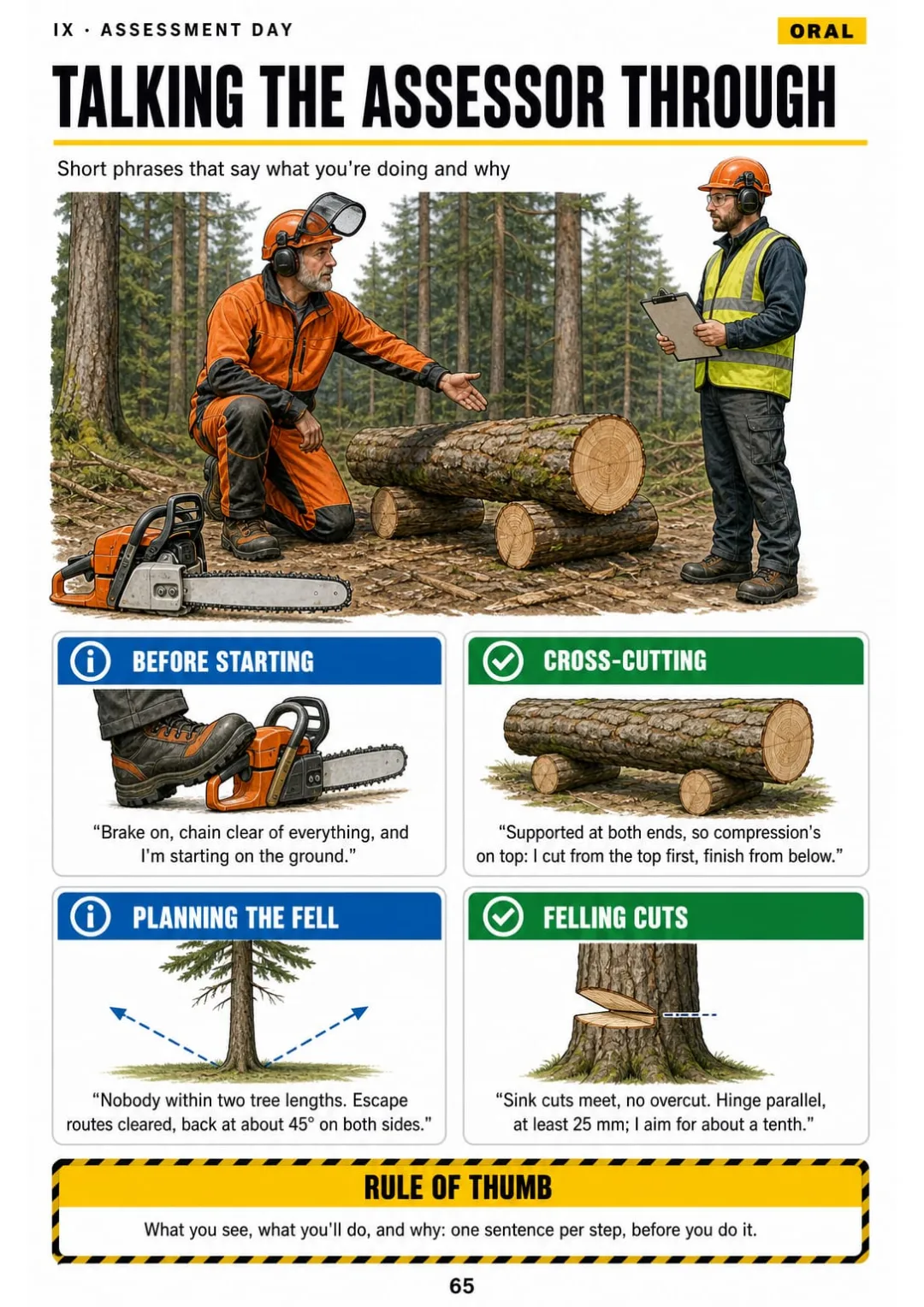
“Compression's on top, so I cut here first”: one sentence per step, in working order.
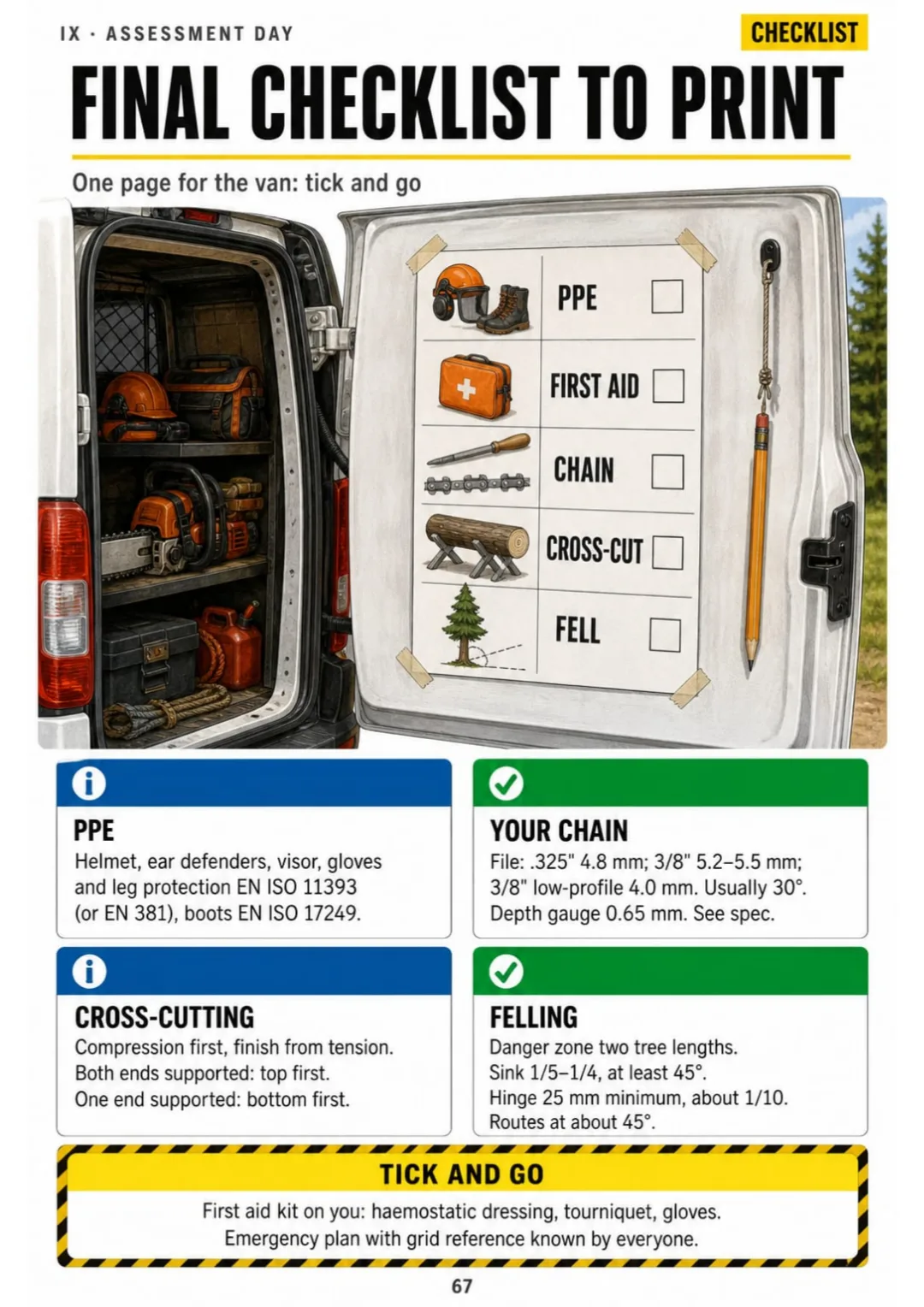
PPE, first aid, file sizes, cross-cut rule, danger zone, sink, hinge, escape routes: tick and go.

Swipe to see more →

These are real pages from the book. The table of contents is the full one: 9 parts and 63 topics.

The Problem Isn't You. It's How It Was Explained to You.

The assessor points at a log propped up at one end and asks: "Which side do you cut first?" You've cut hundreds. Now you have to say why.

The manual covers it in a paragraph on tension, compression and bar pinch. You read it, you nod, and by the time you're standing at the log, the words have gone.

50:1 = 5 litres of petrol + 100 ml of two-stroke oil, mixed fresh

In the book, a log supported at one end is one page: tension drawn on top, compression underneath, cut 1 from below, cut 2 from above, and an arrow showing which way the wood moves.

The same goes for the pre-use checks, the kickback zone, two-stroke fuel at 50:1, the sink and back cut, and a forward-leaning tree: each one has its own page.

You see it, you get it, and you can say which side goes first and why. When the assessor asks, the answer comes out in order.

COMPARE FOR YOURSELF

The Same Topic, Two Ways to Study It

THIS
  • The manual: line after line of text
  • Checks and cuts explained only in words
  • You turn up to your assessment unsure of the order
Prior to commencing operations, the operator shall carry out a visual and functional inspection of the machine in accordance with the manufacturer's instructions. This inspection should include, but is not necessarily limited to, verification of the correct operation of the stop control, the condition and security of all guards, the effective functioning of the chain brake, the condition of the guide bar and chain catcher, the integrity of the silencer and anti-vibration mounts, and confirmation that the chain does not rotate when the engine is running at idle.
FOR THIS
  • The pre-use checks in one drawing
  • The steps numbered in a box
  • Asked about a check, you can picture the page and where it sits in the sequence
Switch, guards, brake, bar, chain catcher, silencer, mounts and the idle test, in one route.
CONTENTS

Take a Look at the 9 Parts and 63 Topics

The ticket and your kit, knowing your saw, maintenance and sharpening, fuel and starting, cross-cutting, planning the fell, felling cuts, snedding and hung-up trees, and revision for assessment day: 67 pages, all illustrated.

IThe ticket, the law and your kit · pp. 5-10
  1. What your chainsaw ticket covers
  2. The law behind the ticket
  3. Chainsaw PPE, head to toe
  4. How chainsaw trousers stop a chain
  5. Personal first aid kit and working alone
  6. Noise and vibration: the two slow injuries
IIKnow your saw · pp. 11-16
  1. Parts of the chainsaw, labelled
  2. The safety features you must name
  3. Inside the chain: cutters, links and depth gauges
  4. Pitch and gauge without guessing
  5. Kickback: the danger quadrant
  6. Pull-in and push-back
IIIMaintenance and sharpening · pp. 17-27
  1. Pre-use checks in the same order every time
  2. Setting chain tension
  3. Testing the chain brake
  4. Choosing the right file
  5. Filing angles and how to hold the file
  6. Lowering the depth gauges
  7. Signs of a blunt or badly filed chain
  8. Guide bar care
  9. Drive sprocket and chain wear
  10. Air filter, spark plug and chain oiler
  11. End of day, storage and transport
IVFuel, starting and handling · pp. 28-33
  1. Mixing two-stroke fuel
  2. Refuelling safely
  3. Ground start, step by step
  4. Leg-lock start
  5. Holding the saw and your stance
  6. Moving with the saw
VCross-cutting: reading the wood · pp. 34-42
  1. Tension and compression
  2. The rule: compression first, finish from tension
  3. Log supported at both ends
  4. Log supported at one end
  5. Bore cuts for logs under heavy tension
  6. Cross-cutting on a slope
  7. Bumper spikes and levering
  8. Logs on the ground
  9. Spring poles: release it slowly
VIPlanning the fell · pp. 43-49
  1. Assessing the tree
  2. Hazards around the site
  3. The danger zone
  4. Escape routes
  5. Choosing the felling direction
  6. Preparing the base
  7. The emergency plan before the first cut
VIIFelling cuts and techniques · pp. 50-58
  1. The three cuts in order
  2. The sink: depth and angle
  3. The hinge: your steering wheel
  4. The back cut
  5. Wedges and the felling lever
  6. Warn, watch and retreat
  7. Back-leaning trees
  8. Side-leaning trees
  9. Forward-leaning trees and barber chair
VIIISnedding and hung-up trees · pp. 59-62
  1. Snedding safely
  2. Branches under tension
  3. Hung-up tree: the never list
  4. Bringing a hung-up tree down
IXRevision for assessment day · pp. 63-67
  1. Site risk notes in five lines
  2. Assessment day in the same order
  3. Talking the assessor through each step
  4. The most frequent mistakes, in one page
  5. Final checklist to print

One Page, One Topic, All Clear

Think of it this way:

It's assessment day, the tree has been picked, and the assessor asks you to talk them through your felling cuts before you start the saw.

In the book you open the felling page and see the sink and the back cut drawn on one stump, with the hinge left between them, each part named and measured, in the order you make them.

Back cut: at or slightly above the bottom sink cut, never through the hinge

The same with the chain brake test, the filing angles, the depth gauges, a log supported at one end and your escape routes: each one on its own page.

Chainsaw Ticket Illustrated is 9 parts and 63 topics, all drawn, and it finishes with a revision section for assessment day, the most frequent mistakes on one page and a final checklist to print.

What you see drawn, you don't have to memorize.

What's Inside Chainsaw Ticket Illustrated:

Ipp. 5-10

The ticket, the law and your kit

What your ticket covers, the law behind it, PPE head to toe, how chainsaw trousers stop a chain, first aid, working alone, noise and vibration.

IIpp. 11-16

Know your saw

The parts of the saw labelled, the safety features you must name, the chain up close, pitch and gauge, kickback, pull-in and push-back.

IIIpp. 17-27

Maintenance and sharpening

Pre-use checks in order, chain tension, the brake test, choosing the file, filing angles, depth gauges, bar, sprocket, air filter, plug, oiler and storage.

IVpp. 28-33

Fuel, starting and handling

Mixing two-stroke fuel, refuelling, ground start, leg-lock start, holding the saw, your stance and moving with it.

Vpp. 34-42

Cross-cutting: reading the wood

Tension and compression, the cross-cutting rule, logs supported at both ends or one, bore cuts, slopes, bumper spikes, logs on the ground and spring poles.

VIpp. 43-49

Planning the fell

Assessing the tree, site hazards, the danger zone, escape routes, felling direction, preparing the base and the emergency plan.

VIIpp. 50-58

Felling cuts and techniques

The sink and the back cut in order, how deep the sink goes, how thick the hinge stays, wedges and lever, warn and retreat, and back, side and forward-leaning trees.

VIIIpp. 59-62

Snedding and hung-up trees

Snedding safely, branches under tension, what never to do with a hung-up tree and how to bring it down.

IXpp. 63-67

Revision for assessment day

Site risk notes in five lines, assessment day in order, talking the assessor through each step, the most frequent mistakes and a final checklist.

At the end of the book: A revision part for assessment day, the most frequent mistakes on one page and a final checklist to print.
Plus: 2 Free Books

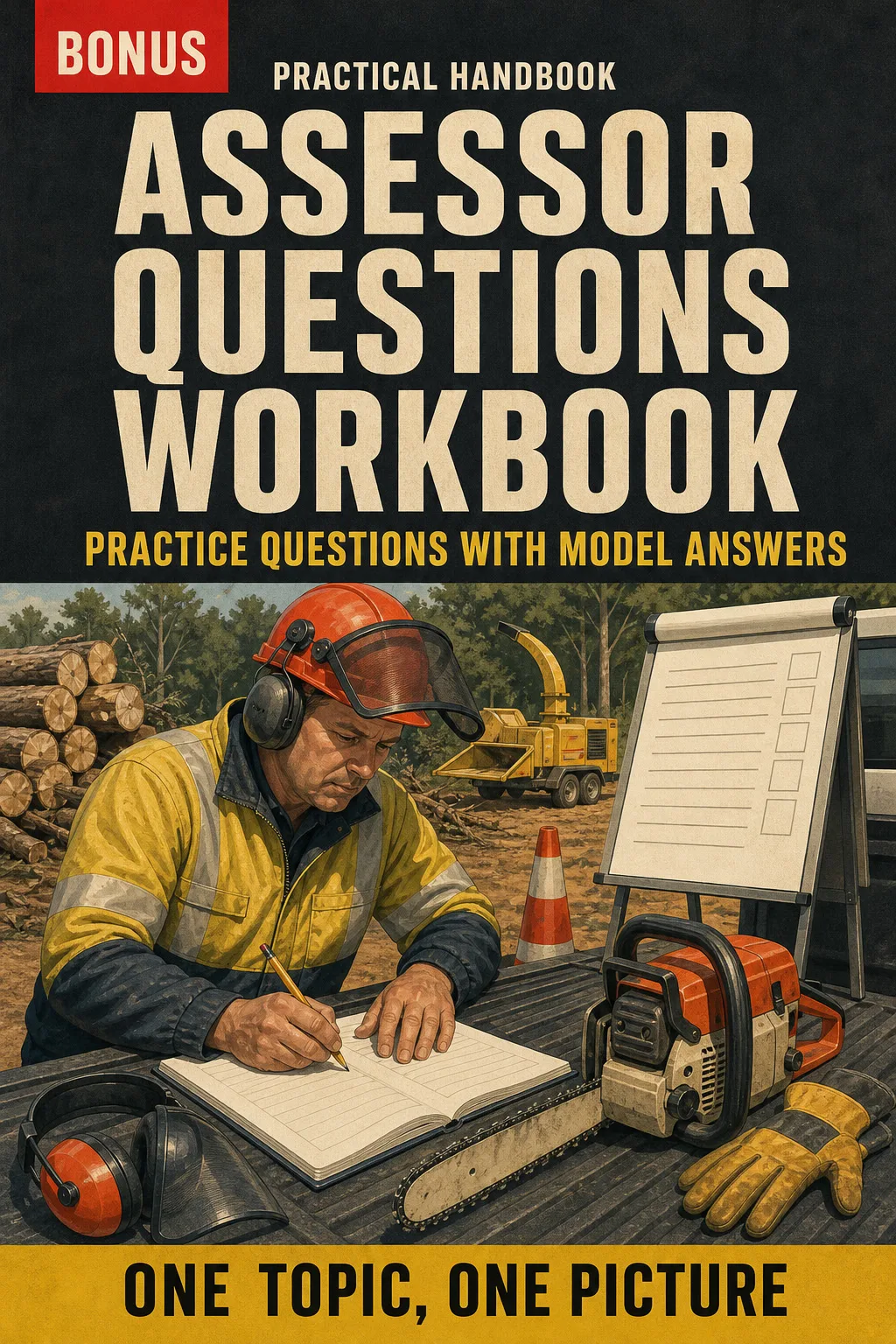
Assessor Questions Workbook: practice questions with model answers

BONUS 1: «Assessor Questions Workbook: practice questions with model answers»

Value on its own: US$ 17.90

Practise answering the questions an assessor is likely to ask out loud, on kickback, hinge size, tension and compression or escape routes, so you don't go blank on the day.

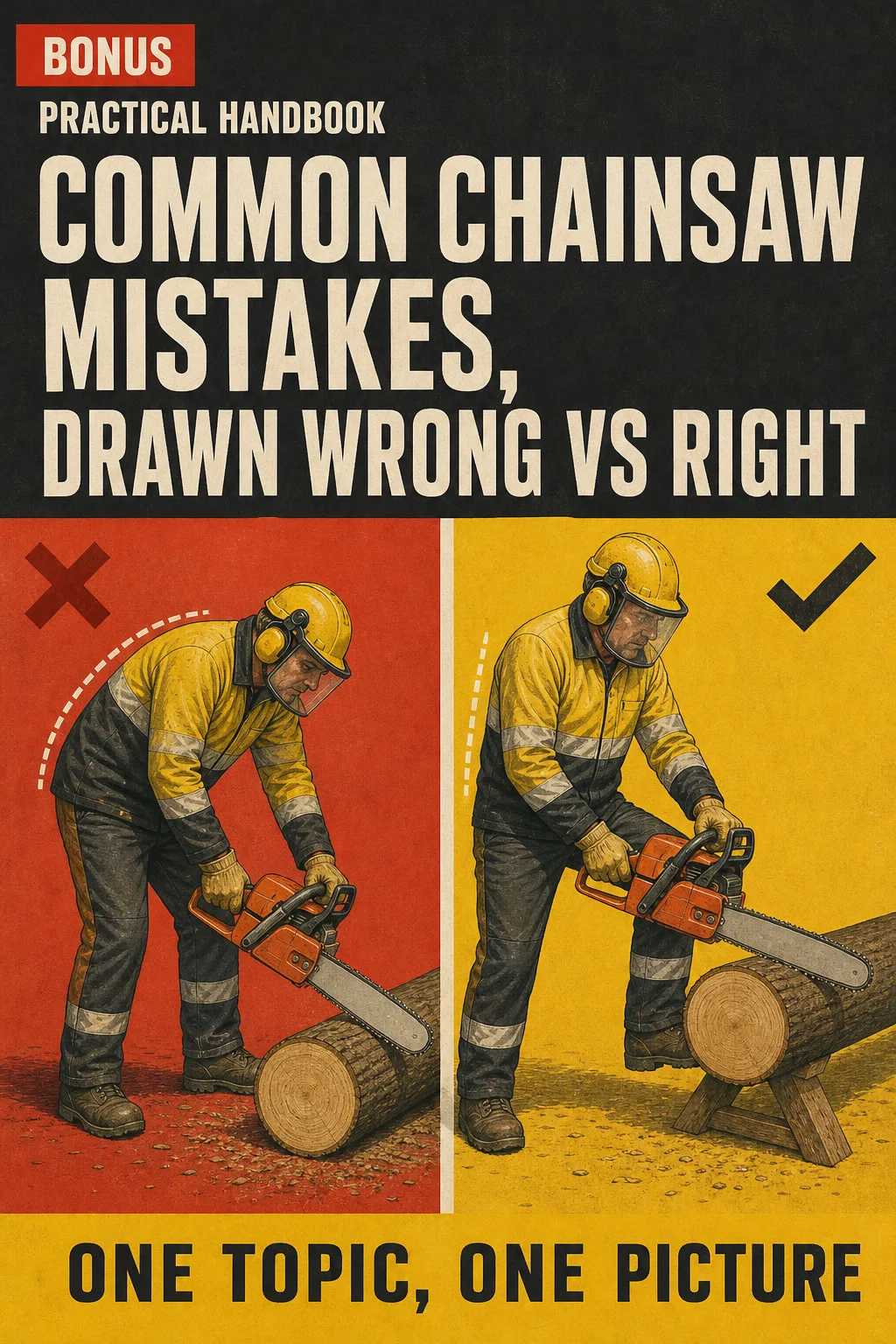
Common Chainsaw Mistakes, Drawn Wrong vs Right

BONUS 2: «Common Chainsaw Mistakes, Drawn Wrong vs Right»

Value on its own: US$ 14.90

The most frequent mistakes in maintenance, cross-cutting and felling, each drawn side by side with the right way, so you can see the difference at a glance before you start the saw.

Chainsaw Ticket Illustrated with 2 Free Books

  • Chainsaw Ticket Illustrated: 67 illustrated pagesUS$ 63
  • BONUS 1: Assessor Questions Workbook: practice questions with model answersUS$ 17.90
  • BONUS 2: Common Chainsaw Mistakes, Drawn Wrong vs RightUS$ 14.90
  • High-resolution PDF to printIncluded
Total value US$ 95.80
YOUR PRICE:
US$ 27
You save US$ 68.80
YES, I WANT CHAINSAW TICKET ILLUSTRATED FOR US$ 27

📄 This is a digital PDF book sent to your email: nothing is printed or shipped.

Secure purchaseEncrypted payment30-day guarantee

PDF by email: We email you Chainsaw Ticket Illustrated as a PDF, together with the two free books. It's a single payment: no installments, no extra charges.

Who This Book Is For

You're revising before the course

You're revising before the course

You've used a saw your own way for years. Each page shows you the checks and cuts in the order the course will teach them.

Your assessment is close

Your assessment is close

The night before, you flick through the drawings and the final checklist, so you can talk the assessor through every step without going blank.

You already work on the land

You already work on the land

Ticket done, you print the pages you need and keep them in the van: sharpening, logs under tension, the danger zone.

Everything You Get Today

US$ 95.80US$ 27
YES, I WANT CHAINSAW TICKET ILLUSTRATED FOR US$ 27

📄 This is a digital PDF book sent to your email: nothing is printed or shipped.

30DAYS
GUARANTEE

30-Day Guarantee

Try Chainsaw Ticket Illustrated for 30 days, bonus books included.

We refund everything if the file won't open, if the book isn't what you see here, if you were charged twice or if the email doesn't arrive. Just email us.

You pay once. No subscriptions.

Frequently Asked Questions

Is it for me if I've used a chainsaw for years but never had the ticket?

Yes. It doesn't treat you as a beginner: it puts what you already do in the order and with the names the assessor will ask for, from the pre-use checks to the back cut.

Where does the content come from?

It's checked against HSE guidance for chainsaws at work (INDG317), the FISA safety guides, the PUWER 1998 Approved Code of Practice (L22), the PPE at Work Regulations, the Control of Noise and Vibration at Work Regulations 2005 and the manufacturers' specifications.

Is it an official City & Guilds NPTC or Lantra book?

No. It's an independent illustrated revision book that follows the topics of UK chainsaw maintenance, cross-cutting and small-tree felling assessments (CS30 and CS31 and their Lantra equivalents). It isn't published or endorsed by City & Guilds, NPTC, Lantra or the HSE.

Does it replace the course?

No. The book doesn't give you a ticket or a certificate: only an approved course and an assessment with an assessor do. The book is for revising before the course, the night before the assessment and afterwards on the job.

Are the practice questions the ones in the assessment?

No. They're written for this book to help you practise answering out loud. They aren't official assessment questions.

When and how do I get it?

The book and the 2 bonus books arrive as PDFs by email, to the address you enter at checkout.

Do I have to pay every month?

No. It's a one-off payment.

Can I have it on paper?

Yes. The PDF is printable: print it at home or at a print shop and keep the pages you need in the van.

How does the refund work?

You have 30 days. We refund everything if the file won't open, if the book isn't what you see on this page, if you were charged twice or if the email doesn't arrive: just email us.

Before You Close This Page

No more rereading pages that don't stick.

The hinge and the back cut: you see them drawn, and that's it.

You turn up to your assessment knowing where everything is.

Drawings make studying faster.

The book is right below.

One-time payment: US$ 27 · Guarantee: 30 days · PDF by email

YES, I WANT CHAINSAW TICKET ILLUSTRATED FOR US$ 27

📄 This is a digital PDF book sent to your email: nothing is printed or shipped.